
What Is Digital Marketing? A Complete Guide for Businesses
In today’s digital world, people use Google, social media, websites, and other online platforms to discover products and services before making a purchase. Because of this, having a strong online presence has become essential for businesses of every size.
Digital marketing helps businesses connect with potential customers through digital channels. It allows brands to promote their products and services, generate leads, increase website traffic, build brand awareness, and drive sales.
Whether you are a small local business, an online store, a startup, or an established company, digital marketing can help you reach the right audience and grow your business more effectively.

What Is Digital Marketing?
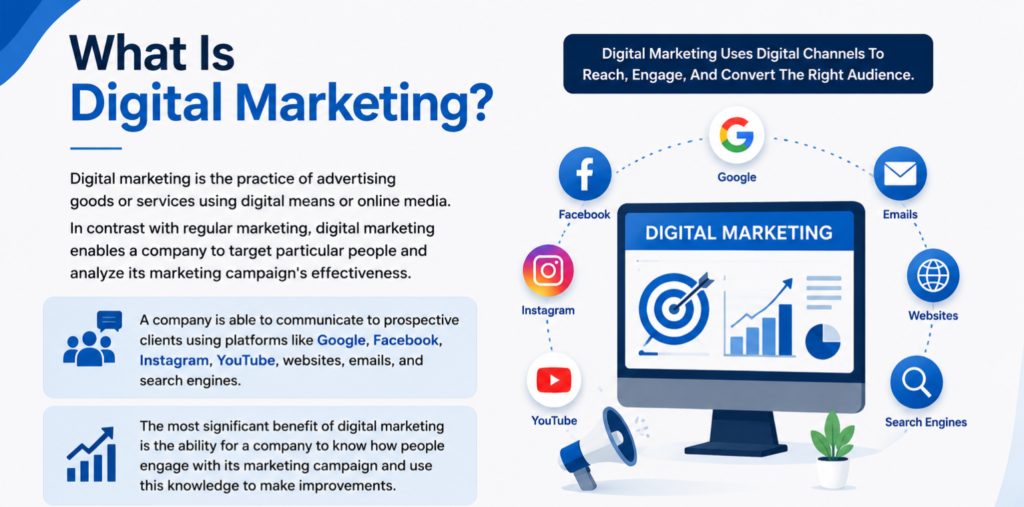
Digital marketing is the practice of advertising goods or services using digital means or online media. In contrast with regular marketing, digital marketing enables a company to target particular people and analyze its marketing campaign’s effectiveness.
A company is able to communicate to prospective clients using platforms like Google, Facebook, Instagram, YouTube, websites, emails, and search engines.
The most significant benefit of digital marketing is the ability for a company to know how people engage with its marketing campaign and use this knowledge to make improvements.
Why Is Digital Marketing Important for Businesses?
Nowadays, people spend even more time online. Prior to making a purchase or contacting a service provider, people tend to conduct research online, compare offers, read reviews, and visit websites of companies they find.
Without having a proper online presence, customers might go to your competitors.
Digital marketing can be helpful for businesses in order to:
Connect with potential customers online
Raise brand awareness
Get leads
Drive traffic to websites
Engage customers
Sell more and generate conversions
Build customer relationships
Measure performance of marketing efforts
The best digital marketing strategy depends on your business goals, target audience, industry, competitors, and budget.
What Are the Types of Digital Marketing Strategies?
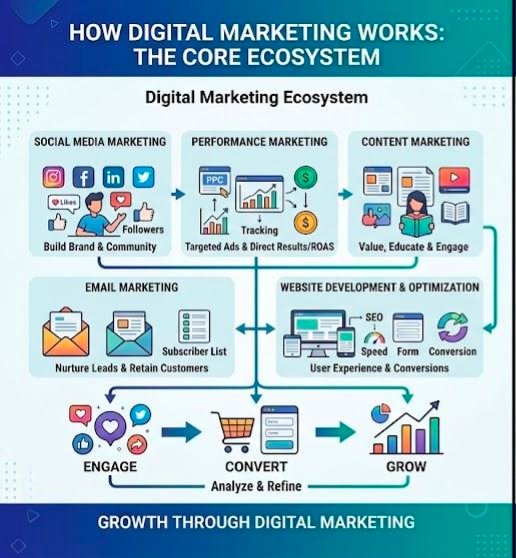
Digital marketing includes several types of marketing efforts. Businesses can apply either a single strategy or combine multiple approaches in order to create a comprehensive online marketing system.
- Search Engine Optimization (SEO)
Search Engine Optimization, usually known as SEO, is the process of optimizing a website in order to rank higher in search results.
Ranking high in Google’s results can be helpful for your business since it helps get more visitors.
SEO is usually comprised of such elements as keyword research, on-page SEO, technical SEO, content development, website optimization, and developing website authority.
In contrast to paid advertising, SEO focuses on attracting organic traffic to your website. In this case, it can be a good long-term strategy.

- Google Ads
Google Ads is a platform for paid advertising that allows displaying ads to people conducting certain queries.
For example, if a person looks for “digital marketing agency near me”, your business can place ads in order to show up in the search results.
Google Ads can be useful for lead generation, attracting traffic, promoting products, and reaching those people who are looking for a solution.
In order to make a successful Google Ad campaign, one should select the right keywords, write compelling ads, target the right audience, optimize landing pages, track conversions, and manage campaigns.
- Meta Ads
Meta Ads allow businesses to advertise on platforms like Facebook and Instagram.
Contrary to search advertising, social media ads allow reaching people depending on their interests, demographic factors, behaviors, and online activities.
Meta Ads can be applied for brand awareness, lead generation, website traffic, product promotion, and conversions.
In order to run successful Meta Ads campaigns, one should create good ads, targeting the right audience,
Creative images, videos, strong messaging, accurate audience targeting, and continuous testing are important elements of successful social media advertising.
- Social Media Marketing
Social Media Marketing involves using platforms such as Instagram, Facebook, LinkedIn, YouTube, and other social networks to build an online presence.
Businesses can share educational content, product information, videos, customer stories, offers, and industry insights to engage their audience.
Social media marketing is not only about posting regularly. A strong strategy focuses on understanding the target audience, creating useful content, maintaining consistency, and building genuine engagement.
- Performance Marketing
Performance marketing focuses on measurable business results such as leads, sales, conversions, or other specific actions.
Instead of simply focusing on impressions or likes, performance marketing uses data to understand which campaigns, audiences, advertisements, and strategies are producing results.
Businesses can track important metrics such as cost per lead, conversion rate, return on ad spend, and customer acquisition cost.
This makes performance marketing particularly useful for businesses that want to make data-driven marketing decisions and reduce unnecessary advertising spend.
- Content Marketing
Content marketing involves creating and sharing useful information to attract and educate potential customers.
Examples include:
Blog articles
Videos
Guides
Case studies
Social media posts
Infographics
Educational content
High-quality content can help businesses build authority, answer customer questions, improve search visibility, and develop trust with their audience.
Instead of directly selling all the time, content marketing provides useful information that helps potential customers make better decisions.
- Email Marketing
Email marketing allows businesses to communicate directly with their customers and potential customers.
Businesses can use email campaigns to share product updates, offers, newsletters, educational content, announcements, and personalized messages.
A well-planned email marketing strategy can help businesses maintain relationships with existing customers and encourage repeat purchases.
- Website Development and Optimization
A website is often the central point of a business’s digital presence.
Your website should clearly communicate what your business offers, who you serve, and how customers can contact or purchase from you.
A professional website should be mobile-friendly, easy to navigate, fast-loading, secure, and optimized for conversions.
Even if your advertising campaigns are performing well, a poorly designed website can result in lost leads and sales. Therefore, website optimization is an important part of digital marketing.
How Does Digital Marketing Work?
A successful digital marketing strategy usually begins with understanding the business and its target audience.
First, businesses identify their goals. These goals could include increasing website traffic, generating leads, increasing sales, improving brand awareness, or entering a new market.
Next, marketers research the target audience and competitors. This helps determine where potential customers spend their time online and what type of content or advertising is likely to attract them.
After that, the appropriate digital marketing channels are selected. Depending on the business, this could include SEO, Google Ads, Meta Ads, social media marketing, content marketing, or a combination of different strategies.
The campaigns are then launched, monitored, tested, and optimized based on performance data.
Benefits of Hiring a Digital Marketing Professional
Managing digital marketing requires knowledge, testing, analysis, and continuous optimization. A professional digital marketer can help businesses develop strategies based on their specific goals.
A digital marketing professional can assist with:
Marketing strategy
SEO
Google Ads
Meta Ads
Performance marketing
Website optimization
Lead generation
Conversion tracking
Campaign analysis
Online brand growth
The goal is not simply to spend more money on advertising. The goal is to use the available budget intelligently and focus on strategies that can generate meaningful business results.
How to Choose the Right Digital Marketing Strategy
There is no single digital marketing strategy that works for every business.
A local service business may benefit from local SEO and Google Ads, while an e-commerce brand may focus more on Meta Ads, Google Ads, content, and conversion optimization.
Before choosing a strategy, businesses should consider:
Business objectives
Target audience
Industry
Competition
Marketing budget
Customer buying journey
Expected return on investment
Testing different strategies and analyzing the results can help identify what works best for a particular business.
Conclusion
Digital marketing has become an important part of modern business growth. From SEO and Google Ads to Meta Ads, social media marketing, content marketing, and performance marketing, businesses have many opportunities to reach potential customers online.
However, successful digital marketing is not simply about being present on every platform. It is about choosing the right channels, reaching the right audience, creating valuable experiences, tracking results, and continuously improving performance.
With a clear strategy and consistent execution, digital marketing can help businesses build a stronger online presence, generate quality leads, increase conversions, and create sustainable growth.
If you are looking to improve your online presence, generate more leads, or build a results-focused advertising strategy, professional digital marketing services can help you create a plan based on your business goals and target audience.